UPBEAT, DOWNBEAT… DEADBEAT! April 2, 2024
Posted by markswill in Uncategorized.Tags: current-events, digital life, navel-gazing, politics
2 comments
Recently chided by a friend about the gloomy nature of many of my blogs, whilst I couldn’t deny it I pointed out that they’re all prompted by stuff I’ve read, heard or seen in the media or have personally experienced. Indeed as I wrote in my March 14th outing, that’s what blogging is all about and if those headlines and my life, and the lives of my sadly diminishing cadre of close friends, aren’t an endless round of unalloyed joy, rest assured it’s been reflected in these doodles. However I’ll start this one by mentioning that as I write I’m looking out at sunny blue blue skies and I’ve just had an Easter weekend with Nurse Jenny from London joining me for a boisterous supper party here, my first post-sciatica walk in the woods sans crutch, and even though my leg wasn’t quite up to dancing madly, an otherwise fabbo triple birthday party. So it’s not always doom and gloom but…
A piece in the i caught my attention last week noting that the National Institute of Health says one in eight 13–18 year-olds is suffering from clinical anxiety, an increase of 27% between 2016 and 2019, and for adults it’s risen by 24%. A little internet rummaging persuaded me that those figures must be connected to the claim that a shocking one in five people in the UK, including 3.9million children, live in poverty, whilst real average household incomes have fallen by 5.7% over the past year!
All those figures are also surely if only partly a consequence of the cost of living having risen by 4% during the past 12 months (Consumer Price Index) and owner-occupiers’ housing costs have risen by 4.2%. I’m relatively lucky because I don’t have children to raise and my largely pension-based income has remained steady or in-line with inflation, but although no longer clinically anxious – and I’ve the tests to prove it! – I can’t honestly say that I’m consistently happy. Are you? However that has much to do with the awful state of a country beset by cuts in local and national government funding of the things I hold dear, indeed necessary, for a decent life. And our depressing post-Brexit, post-Covid world clearly affected by wars in Ukraine, the middle east and Africa and the rise of totalitarian leaders across the globe will only get much worse if Trump becomes the next US president.
So perhaps it’s no wonder that the UK’s birth rate has plunged to 1.5 children per woman – who’d want and could afford to raise kids nowadays? – well below the 2.1 figure deemed essential to maintain a stable population whose taxes will pay for us deadbeat pensioners… but not as low as Japan’s 1.2 which prompted its biggest nappy manufacturer to stop making them for babies!
And in keeping with my law-of-unintended consequences jag in recent blogs, is one reason for failing birth rates the fact that young adults no longer connect and ultimately mate with each other? Well again according to today’s i (April 2nd) the World Health Organisation says this inability “fuels profound loneliness and unhappiness…” making it “difficult to converse in the physical world” and is – I’m afraid, obviously – “because their lives are increasingly online”.
Which echoed a great feature on last Saturday’s Times magazine by 31 year-old James Marriot who noted that the average person spends almost four hours a day on their smartphone, rising to seven hours for Gen Z-ers! Consequently, “A diversity of human leisure experiences – reading, playing, sewing, concert going, eating out – is steadily reducing to the only real hobby a lot of young people have nowadays: going on their phones.”
Echoing my own observations he noted you “don’t have to be a Luddite to find the ‘phone zombies’ lurching down every street a little dystopian”. Or the sadness of couples in any restaurant too glued to their phones to talk to each other. Of course a prime reason for this is the addictive algorithms imposed on we smartphoners – for example look up a song on YouTube and you’ll be enticed to check out three different versions, and then other songs by some of the bands who performed them and so on. Indeed the whole premise of Instagram, TikTok etc. is to inveigle you to link to other users of similar interests so you spend more and more time addicted to your little black mirror enabling these world dominating mega-corporations to flog more and more adverts.
The writer Eliane Glaser has never had a smartphone (“They just feel evil”) and recommends various “rackety workarounds… I draw lots of maps, I ask people directions…” but happily “most software engineers designing systems for, say, cinema or theatre tickets build in workarounds for people whose phones are dead or lost” and thus can’t scan those wretched QR codes that increasingly act as gatekeepers to, well, almost everything.
Marriot decided to abandon his smartphone for a basic push-button job – “a real drug dealer phone” that only does calls, texts but has a torch so’s you can check your A-Z map in the dark. That meant abandoning Uber, Snapchat etc. whilst limiting his use of WhatsApp and GoogleMaps to his laptop when strictly necessary which in my case would be straight after breakfast and just before supper… or when I’m pounding away at an inconsequential blog.
And although I’m not about make a valiant effort to up the birthrate, or spend my time in a ‘men’s group’ huddled in an allotment shed so’s to stave off my isolation, I’ve decided to follow suit with a twelve quid (!) Nokia 106 – from fleaBay I’m afraid – which’ll take my existing SIM card and should life become profoundly ‘lonely and unhappy’ without my 2019 Huawei Y6, I can always switch back to it!
Oh yeah, and there’ll be more tomorrow…
IF YOU ENJOYED THIS, OR EVEN IF YOU DIDN’T, WHY NOT SIGN UP TO RECEIVE EMAIL ALERTS TO FUTURE BLOGS USING THE LINK IN THE R.H. COLUMN?
NOT FOR SISSIES March 18, 2024
Posted by markswill in Uncategorized.Tags: Medical Notes, navel-gazing
4 comments
Possibly due to being relatively incapacitated and with too much time on my hands, blog-wise I’m on a bit of a roll nowadays so here I go again…
The first topic raised when I had a drink with an old friend last Thurs was the number of funerals we’d been to in just the past two months, and a greasy spoon lunch with another the next day quickly echoed that. Which almost inevitably had us all swopping notes on our own heightened sense of mortality and physical ills, the latter prompted by my hobbling around on a crutch and the imminent passing of a very dear old friend, once so sparky and active but now suffering from a terminal brain tumour, who could no longer see and could barely manage to talk to me when I visited earlier that week.
All of which reminded me of Bette Davis’s quote: “Getting old is not for sissies.” But what follows is not an exercise in self-pity but I hope instead a modest dissertation on the realities of ageing, and how to deal with it.
I begin with a metaphor: Our bodies are essentially machines which like the cars and motorbikes I’ve spent a lifetime obsessed with, wear out as they get older. And the more complex they are, the more prone they are to that and breaking down, especially if poorly maintained. Testimony to that is the two cars and five ‘bikes I bought new never broke down before I sold them, but then I rigidly stuck to the manufacturers’ maintenance regimes and in the case of my off-road ‘bikes, applied upgrades and preventative maintenance!
And it’s true that middle class obsessions with defensive body maintenance, as exemplified by gym membership, chugging down ‘health’ supplements, foreswearing tobacco, alcohol and ultra-processed foods, taking up yoga, tai-chi and the like are the behaviour of the ‘worried well’ who fret about their mortality. Someone close to me used to playfully chide me as being one of their number, but rather changed their tune when diagnosed with a potentially life-threatening ailment and is now on serious meds for the duration. And an ex-colleague who’d made a lucrative living catering to the aforementioned neo-hypochondriacs was hospitalised with serious nutritional disorders stemming from their extreme dietary regimen.
But apart from the meds I’m on for high blood pressure and cholesterol, and more recently sciatica, I’ve deliberately avoided overdoing all that, instead relying on long walks, cycling and modest upper body exercises, fairly sensible diet, eschewing roll-ups and limiting boozo the wonder drug to keep my own figurative house in order. Which although it might sound a bit smug, is probably little different to most of my friends, peers and possibly you, dear reader.
However during the course of those aforementioned conversations, which even 20 years ago would likely have been mainly about music, films, parties, jaunts, cars, ‘bikes, aircraft, boats, books and even – gulp – our relationships, instead covered health issues associated with getting bloody older. And as I alluded earlier, after initial pleasantries, so many conversations with friends and peers of my age quickly become litanies of ailments, the plain evidence of bodies and brains wearing out.
So amongst those of us in our 70s, the ones that didn’t die in their 60s or earlier – by the way, that’s seven in my case – many have had (or now need) replacement hips or knees, heart operations, strokes, cancers of various types (25% of the population we’re told!) and other essential remedial work which nevertheless has changed their lives, often not for the better. Others have succumbed to Alzheimer’s or like me, sometimes can’t remember what we went upstairs to get or words we want to put on the page, the names of rock musicians or actors we youthfully revered, or an email we should’ve answered yesterday. Hair loss in both sexes, faded libido and inability to ‘perform’ adequately even if it hasn’t, false teeth or implants for the better off, arthritis, deafness, sight loss, changed facial and body shape, diminished bone density and spatial awareness… the list goes on and on and I don’t believe that anyone in their 70s does not know someone who hasn’t experienced such things.
However even if we reluctantly accept that some of the above are inevitable as we wear out, and that death will eventually come and hopefully quickly and painlessly, there’s still much to cherish which trying to maintain a positive attitude is essential to. Okay, that’s sometimes not easy, especially for those living alone without anyone to cheer, reassure or care about, if not in extremis, for them.
And in my opinion this life-enhancing – if not life-saving! – positivity means keeping your brain and body working as best you can without succumbing to hypochondria, fitness addiction or as with some mega-rich loonies, cryogenics and syphoning off and transfusing your children’s blood! And that in turn could embrace using your time for fun, travel and adventure and whatever that means to you – but spare me cruise ships – plunging yourself into hobbies new or old, chatting with and visiting friends, reading, learning and doing more than just slopping in front of t.v. And if your career is over, volunteering for things that make others, and maybe you, feel good but not, dear gawd, that requires polarising social media.
Oh, and to return to where I started, piloting beautiful, exquisitely engineered and powerful machines at high speed into the sunset high on, well if not drugs these days, adrenalin… which is at least one thing that age cannot wither!
IF YOU ENJOYED THIS, OR EVEN IF YOU DIDN’T, WHY NOT SIGN UP TO RECEIVE EMAIL ALERTS TO FUTURE BLOGS USING THE LINK IN THE R.H. COLUMN? AND DO PLEASE COMMENT ON THIS ONE USING THE LINK BELOW THE ADVERTS… GO ON THEN!
LOVE YOUR LOCAL ROBOT March 15, 2024
Posted by markswill in Uncategorized.Tags: current-events, digital life, navel-gazing, politics
1 comment so far
Yesterdays’ – yesterdays! – blog touched on the unconsidered and mainly negative effects of Britain’s rapidly rising population growth and other such unintended consequences are now legion.
Take the drive towards green energy which means many more onshore wind- and solar-farms which not only blight the steadily eroding rural landscape in generating the electricity, but require a vast network of unsightly new pylons to carry it to the national grid. This in turn has a damaging effect on tourism in parts of the country which rely heavily on it for jobs and exacerbate polarisation that already exists between rural and city dwellers and thence between local, county and national governments, and so societal cohesion become even more fragile – see yesterday’s blog.
And in the parallel race to push us all into buying expensive electric vehicles which must be charged, not only does that threaten many traditional motor mechanics who cannot properly service them but because electric cars are much heavier adds to the already woeful deterioration of our road surfaces which there’ll no longer be garages to repair their broken suspensions and burst tyres. And since county councils charged with repairing and maintaining our appallingly pot-holed roads can no longer afford to do so, working days and business will be lost by people and companies who have to use them. Also, as many people already won’t drive at night because it’s so hard to dodge the dangerous surface conditions, this has a knock-on effect on the pubs, eateries, venues and suchlike already clinging on by their fingernails to stay in business, which in turn adds to unemployment, depression and isolation and, yes, mental illness which the NHS cannot cope with.
Neither, by the way, can it cope with the escalating obesity problem which the government refuses to address in the way it did with smoking, something which costs it £6.5billion annually with 26% of adults and 23.4% of children now clinically obese, and the consequence of that is obviously an added strain on healthcare and social care budgets. Ah, but it does benefit purveyors of mobility scooters, mostly made in China, which clog up pavements not intended for their use and often forces pedestrians into streets where they’re soaked by wash from puddle-filled potholes or, worse, hit by silent electric cars!
Now you might consider any of the above assertions fanciful, but what is clearly not is the rapid and unchecked rise of artificial intelligence (AI). We are already hearing about all manner of companies, institutions and indeed police forces using AI to do work once done by humans, the justification being not that it saves them money, but that it frees staff to do other things. Ho, ho, ho. But of course never mind putting vast swathes of people out of work, and though it will save them money once they’ve amortised the initial costs, dealing with a robot or being arrested on the basis of a flawed facial recognition app offers little chance of redress. And certainly no chance of understanding the human emotions harmed or ignored by AI.
Concerned about its evidently unstoppable rise, 44 year-old academic Eliezer Yudowsky told the Guardian that these super-intelligence marvels are already “too fast and too ambitious for humans to contain or curtail. Don’t imagine a human brain in one box,” he adds but try to picture “an alien civilisation that thinks a thousand times faster than us” in lots and lots of boxes. He also said he had “a sense of (civilisation’s) remaining timeline looking like five rather than 50 years” !!!
Nick Hilton, who hosts the ‘neo-luddite’ podcast The Ned Ludd Radio Hour, said “what we are facing (due to AI) is a widespread loss of purpose,” adding “My work is tech-based, I can’t avoid it. (But) I’m not some person living in the woods, I am anxious… I feel things fraying.”
Well as I’ve alluded to in recent blogs, so do I and it’s an anxiety that adds to a more general and widespread sense of fear, of being plunged into unknown territory that many of us are now experiencing, something that’s out of control, or at least out of our individual control. I’ll admit that this may be a consequence – love that term – of the age I am, and that my parents may’ve felt the same when Mick Jagger pranced around the stage in velvet flares and It magazine, for which I was music editor, ran the slogan ‘There Is No Hope Without Dope’ in the ‘60s. But what is undeniable is that business, government at all levels and utilities increasingly or in some cases exclusively deal with individuals digitally. Just today I tried unsuccessfully to talk to a human being, or even send an email to challenge the basis on what my water bill had just been raised to instead a chat-bot couldn’t even understand my request to talk to a human, but texted that they – who are ‘they’? – would get back to me… within 10 days!
Yes, there are digital natives decades younger than me who have no problems with all this and yet, and yet… the rise in serious mental illness amongst youths who have grown up in front of a screen has risen to 25% from 6% two decades ago. Social graces, independent thinking, intellectual reasoning, the ability to interact with and love family and friends all are alien to many of those young people. And receipts of our online deeds, which are too many the average human psyche can stand to know, are time-stamped and archived by data farmers answerable to no-one except their owners, with ambiguity, lovely ambiguity, now lost somewhere between the ones and zeros. But hey, it’s okay because we can trust messrs. Zuckerberg, Musk, Pichai etc. to bestow on us their benign approach to mankind’s future… and will be using AI to ensure we believe them!
IF YOU ENJOYED THIS, OR EVEN IF YOU DIDN’T, WHY NOT SIGN UP TO RECEIVE EMAIL ALERTS TO FUTURE BLOGS USING THE LINK IN THE R.H. COLUMN?
WHEN A BUTTERFLY FLAPS ITS WINGS IN NEW MEXICO etc., etc… March 14, 2024
Posted by markswill in Uncategorized.11 comments
Blogs are by nature very personal things so inevitably reflect the personal circumstances of the scribbler, and thus it was with my last two outings. Indeed I’ll begin this one by sincerely thanking many friends and well-wishers who responded so kindly – some actually with phone calls and physical help! – to my tales of sciatic woe and equally woeful NHS treatment. However whilst not wishing to prolong their or indeed my agony, I’ll just say that it’s s-l-o-w-l-y improving and the chiropractor I saw today (March 14th) said it should be entirely over in 4 – 6 weeks, which is some small solace. And as mentioned before, my relative incapacitation has allowed me to read and ruminate more than usual about stuff, which brings me to topics which have become, yes, domestically topical, at least media-wise of late, and which could have profound knock-on effects.
The first was exemplified by a thoughtful though I suspect contentious piece in last Saturday’s Times by David Goodheart, entitled ‘No wonder UK is so divided – we’re too diverse’. Now I’ll admit that Goodheart is something of a friend who I’ve admired ever since he founded Prospect magazine in 1995 and although I disagree with him on many issues he is never afraid to cogently challenge sacred cows. And in this article he made the point that because ethnic minorities have grown from 9% of the UK population to almost 30% in the last 20 years, our societal cohesion is breaking down and individualism, which, by the way, has been wholeheartedly endorsed by politicians from Mrs Thatcher onwards, leads to this: “An increasingly individualist future in which we don’t know our neighbours and society is a collection of networks of kin and friends, (and) is not appealing.”
His thesis continues: “Many older people look at the national media, or at London (now barely 30% white British) and feel they have lost their country.” As an older person, I’m only slightly sympathetic to that viewpoint but then I live in rural Wales where I’d venture 99.9% of the population are white and British. What is undeniably obvious, certainly when I’m in London, is that there is a mainly ethnically, religiously and/or ‘individualistically’ driven fragmentation which you can see in foodbanks, outdoor markets, fast-food chains, healthcare, entertainments and a widening gulf between haves and have-nots, much of it a consequence of escalating levels of poverty, and the way in which these ‘fragments’ deal with it.
But of course such diversity can be a good thing if those embracing it recognise its many benefits – for example immigrants doing the jobs that work-shy Brits won’t – but overall Goodheart thinks not. At its most extreme, the toxic confrontations between jews and muslims – and I have muslim friends who don’t hate jews, and jewish ones who only hate Netanyahu – has fostered a polarity that will have longterm consequences for us all. And I don’t mean just the escalating social fragmentation alluded to earlier, but the fact that central London, and indeed other cities when protest marches occur are becoming no-go areas for shoppers and tourists, meaning that police resources are being further stretched and the costs involved means that other law enforcement suffers and that bandwagon-jumping politicians have less time, or inclination, to adequately deal with the many other ills society endures.
And such are the unforeseen consequences of, well, ‘stuff’ that prompted my headline which you may recall is a Chinese proverb which continues “…it can cause a tornado in Beijing”.
Taking my analogy a little further, since 2013 Britain’s population has grown by over 4 million to 68million, 561,000 of them being immigrants in just the past four years. Now I won’t pontificate on the rights and wrongs of legal or illegal immigration on this tiny island or the polarised reactions of politicians etc., but clearly this has a material effect on everyone. Take housing, for example. With not enough homes to go around, there’s pressure on local authorities to nod through permission for private companies to build more homes, but almost all of which are unaffordable to young or already cash-strapped citizens, of whatever ethnicity or religious persuasion. A knock-on effect of this is those old, white city-dwellers who feel uncomfortable or even threatened and also increasingly impoverished, selling up and moving to suburbs or the countryside which pushes up prices in those areas where there is already a critical shortage of accommodation, e.g. where I live. And where there is little or no retail, social, health or public transport infrastructure to build or maintain social cohesion.
There is also pressure on resources like water, sewage and other already underfunded council services which everyone then suffers from. And more land is sold at huge profit to just a few farmers who then take it out of production which in turn leads to shortages of affordable, home-grown produce and the emergence of industrialised agriculture which pulls out hedges, damages roads that were not built for heavy machinery and pollutes waterways, which in turn damages bio-diversity. By the way, no new reservoirs have been built in Britain since 1989 (thank you privatisation!) and the state of sewage provision is so dire that one small privately-built estate of the execrably misnamed ‘executives homes’ remained unoccupied for a year because our local treatment plant couldn’t handle it. And conversely the once mighty River Wye which flows through my patch is, like most of its fish species, now dead thanks to chicken farm run-off which Hereford County Council refuses to legislate against! Yet the government aims to build 300,000 new houses a year – so far, so pie-in-the-sky – but at what cost to already over-stretched resources, the environment, and society generally?
Before I’m accused of going all Tommy Robinson, I’ll stop right here and if you can bear it, scribble a companion piece which also tackles an even more worrying, topical issue which I hope to post tomorrow. You have been warned!
IF YOU ENJOYED THIS, OR EVEN IF YOU DIDN’T, WHY NOT SIGN UP TO RECEIVE EMAIL ALERTS TO FUTURE BLOGS USING THE LINK IN THE R.H. COLUMN?
ON OUR LAST LEGS March 3, 2024
Posted by markswill in Uncategorized.Tags: current-events, Medical Notes, navel-gazing, politics
4 comments
Further to last week’s sciatica-focused outburst and morbidly curious, I revisited posts I made when I was last incapacitated in the summer of 2022 – in that case following a minor ‘bike accident – and noticed a couple of similarities which will inform this one. Firstly:
“My much bewailed singleton (or cantankerous old bugger) status means that a few kind neighbours are now regularly prevailed upon to help me out, some even cooking the odd meal as standing in the kitchen for prolonged periods is awkward and painful.”
Of course I’m hugely grateful for such ministrations again now, but still living alone I’m even more embarrassed than usual to ask for help in ameliorating and coping with my enforced isolation. And “cantankerous old bugger” was a hopefully amusing self-deprecation of the sort familiar to my long-suffering reader but I mention this here for its relevance to another line from that August 2rd 2022 blog, namely:
“…the upside – if you can call it that – of all this (my inability to move around much), is that is has allowed me more time for reading and binge-watching films and streamed t.v. and, of course, thinking.”
But the recreational activities prescribed by my current incapacitation are now informed by the need to arrange myself physically in such a way that the leg pain, often extreme, is minimised which means lying prone, standing up or sitting in a straight-backed chair, i.e. less t.v. and more reading. As for the “thinking”, well last time that augured more than the usual angry blogs about the State Of Things, whilst now it’s more about my own place in the world, a world that has become dominated by the state of U.K. healthcare which I am inescapably dependent on or arguably, a victim of.
Leaving aside “my own place in the world” which I’ve regularly wittered on about over the years, last week my firsthand experiences of hospital and local GP ‘care’ (sic) bemoaned an NHS in crisis and the dreadful lack of joined-up management between Welsh and English health services which an article in yesterday’s (March 2nd) Times Magazine threw into grim perspective. Titled ‘The NHS Is Like A Warzone’ it painted an alarming picture of worn-out staff, often in tears at the end of lengthy shifts and exiting the profession in droves, as well as run-down facilities and shortages, some I’d recently experienced myself. And my friend Frank’s recent experiences when requiring urgent cardio-vascular surgery, as he recalled in a post-blog comment, provided an even more serious critique.
The original and admirable Bevan-ite slogan ‘Free at the point of delivery’ in principle remains. Yet with so many NHS services outsourced to profit-motivated companies and the inexorable rise in demand, some of it via the national obesity epidemic which our government refuses address so’s not to upset Big Food, I genuinely fear that in order to stay healthy, get treated for and recover from ailments and live to a ripe old age with dignity and security is now nigh impossible.
Of course there are exceptions – notably cancer treatment if it’s diagnosed early enough – but for many the only route to healthcare more widely is to go private and this, too, I’m now being forced to take. Since this wretched sciatica kicked off, I’ve spent hundreds of pounds on physiotherapists and osteopaths who from a position of ignorance I had to research myself, if to little or no avail, and I was talking to John, another fellow sufferer, albeit whose sciatica is the consequence of an underlying malady who has spent even more, and another friend, Kate, who some years ago outlaid many thousands and ended up in Harley Street for the steroid injection which almost overnight solved her problem.
And at an appointment with a largely disinterested nurse at my local surgery – there was over a fortnight’s wait to see who I once regarded at ‘my’ doctor – I learnt that there’s another fortnight’s wait to see an NHS physio who in any case wouldn’t manipulate my spine to try and free the offending trapped nerve but would instead refer me elsewhere!!! So it’s back (sic) to research and badgering previously afflicted friends for recommendations to privateers, ideally chiropractors who are adept at clicking vertebrae rather than varying types of massage… and laying on of hands for heaven’s sake. (The local listings magazine which I contribute to and indeed help distribute, though obviously if guiltily not this month, includes pages of ‘Complimentary Medicine’ purveyors most of whom seem unqualified except by trade bodies which provide medically irrelevant initials after their names, and who seemingly pander only to the well-heeled, worried well).
So where this leaves me is that despite the industrial-strength painkillers perhaps masking any tangible signs of recovery, I’m hopeful that I will eventually return to a life once lived, even though that may be a life without long, spine-pressuring car journeys and/or a reliance on the state to look after me when I can’t or I fall ill. Depressing? Yes, at least for now. But as I wrote last week, it further enhances my admiration for those worse off than me medically… and financially. Oh, and with lots more thinking time available, I’m limbering up for future tirades which hopefully won’t be about the NHS.
IF YOU ENJOYED THE ABOVE, OR EVEN IF YOU DIDN’T, WHY NOT SIGN UP FOR ALERTS TO FUTURE BLOGS USING THE BOX IN THE R.H. COLUMN? AND DO PLEASE ADD YOUR COMMENTS USING THE LINK BELOW.
PAIN IN THE BUM… AND BEYOND February 27, 2024
Posted by markswill in Uncategorized.Tags: Medical Notes, navel-gazing, politics
11 comments
It began with a brief trip to London, the first for ages by car via a friend’s funeral in Hereford but ended… well it hasn’t actually ended but 13 days later I am about to attempt to drive back to Wales primarily, and ironically, to attend another dear friend’s funeral.
‘Attempt’ because in the interim I have been in near constant pain, the most excruciating I’ve ever experienced and that includes a couple of ‘bike accidents, some horrible backaches and a few migraines… but not, course childbirth! The root cause is sciatica which extends from my left buttock down in my thigh and calf and which for three days made it almost impossible to get out of bed without nearly fainting from the searing agony and obliged the dear friend I am staying with, happily Jenny is an ex-nurse, to fold me into an Uber and take me to Homerton Hospital A&E. And I’m telling you this not out of self-pity – heaven forfend! – but to pass on my firsthand experience of an NHS in terminal decline, mainly due to government mismanagement and inadequate funding.
In fact on a Sunday afternoon, after triaging by a polite but clearly weary nurse, I had to wait ‘only’ three hours to be seen… not by a doctor but a prescribing nurse who without bothering with a physical examination or X-ray, identified the sciatica for what it obviously was and gave me some serious painkillers but not the strong anti-inflammatories he said I needed, “Because we’ve run out”!!! He said I should get my GP to issue a prescription and forward it to chemist in London but when I rang my GP I was told that being in Wales, it was illegal to do do that to a chemist in England!!! And the only way around this was to go back to Homerton and ask them to make out a scrip for a London chemist which despite further almost intolerable Uber rides, we then did the next day.
I should now add that I’d had mild sciatica for some three weeks before I left Wales which was bearable apart from sitting down and getting up, and I twice visited an osteopath there but as well as his un-advertised Reiki technique, which is frankly medical mumbo-jumbo, he made damn all difference, except of course to my wallet. And the A&E medic, and my personal Florence Nightingale, told me that the four hour car journey here greatly exacerbated the condition during which I should’ve stopped every 30–45 mins to relieve the nerves trapped in my spine that were causing it. She also sternly told me a physio rather than an osteo was what I need but guess what, even the physios at the hospital I’d attended, and even the ones who worked privately out-of-hours, couldn’t see me for some three weeks!
And it gets worse, or even madder. By the following Saturday, I’d run out of the meds I’d got from A&E and was advised that there was now a 5 – 7 hour wait at A&E because of the current five day junior doctor’s strike, so going back for more was hardly an option at a seriously overburdened hospital. Another desperate call to my Welsh GP surgery elicited the fact that they’d have to get my records from the Homerton – which unsurprisingly they couldn’t – before they’d issue a repeat scrip which of course could only be honoured in Wales, and anyway I’d have to nominate a friend to collect and post it to me in London. So at the time of writing I now have a physical appointment booked there just prior to the funeral… always assuming I can manage the drive home.
Quite apart from my empirical and yes, hyper-critical encounters with an ailing, disjointed and underfunded NHS that’s left me still floundering in severe discomfort and pain, this all brought home how ghastly it must be for people who live in constant suffering with arthritis, osteoporosis or the like, to whom I’m now in massive awe of. And as we’re all getting older and thus prone to conditions that incapacitate, it is, I’m afraid, only going to get worse, as my admiration for them gets greater.
IF YOU ENJOYED THIS, OR EVEN IF YOU DIDN’T, WHY NOT SIGN UP TO GET FUTURE BLOG ALERTS USING THE FACILITY IN THE R.H. COLUMN? AND DO COMMENT ON THIS ONE, AS BELOW
BROKEN BRITAIN? January 8, 2024
Posted by markswill in Uncategorized.Tags: current-events, navel-gazing, politics, transport
3 comments
It’s typical if not traditional to look forward to a New Year with optimism and a mind to make resolutions and with one small, rather embarrassing exception for 2024 I always shy away from the latter because they’ve long since been broken, usually within a matter of days. But although ever the optimist – hah! – I can’t see that the next 12 months are going to be good. Just this week’s national news confirmed such doubts, and here’s why.
The latest and just cancelled London tube strike would’ve meant that many of its already beleaguered citizens were going to be further inconvenienced and I myself had to cancel a plan to go there, primarily to do my very first podcast for Rock’s Back Pages (www.rocksbackpages.com) centred on the imminent launch of a book featuring the often hilarious journalism of the late, much-missed Tom Hibbert, a friend and colleague who worked for and with me during the ‘70s and ‘80s. The strike was of course just the latest industrial action that have seen the NHS pushed into meltdown, the railways into a state of crippling unreliability set against ever–escalating ticket prices, and public services like water, fire and telecoms generally descending into dismal uncertainty… ditto arts funding and the cultural nourishment and export income that it provides.
On top of that I learnt from BBC R4 on Sunday that last year the AA had some 50,000 call-outs per month last year due to pot-hole damage and recorded many deaths of cyclists and ‘bikers… and also that £130million the government allocated for flood prevention which could’ve avoided ruining of thousands of homes and businesses this past week was not used. And then we also heard the news that the government is finally minded to overturn the convictions of some 900 branch post office masters/mistresses who were wrongly accused of defrauding the Post Office due to the deeply flawed, imposed-from-above computerisation of their businesses, a long running debacle which ruined and in some cases ended the lives of thousands of innocent people and which we must thank the t.v. docudrama, Mr Bates vs. The Post Office for forcing the issue. So much for the power of journalism and the morality of politicians who turned a deaf ear to it for almost a decade.
And that, plus the unspent flood prevention monies, along with the signing off of billions for the ludicrous, now truncated HS2 scheme throws the political priorities, never mind its management proficiency, of the Treasury into serious question.
Consequently, we should be asking ourselves, and our public servant/masters, whether things like the railways, the water industry and postal services should be re-nationalised? It’s becoming obvious that so-called public companies, even where the government is a major shareholder, cannot run such operations efficiently which of course they do using a profit motive and borrowings that ramp up consumer prices, often to obscene levels. Of course re-nationalising them would be expensive in the short-term, but the tiers of management and their supply chain cronies that privatisation inflicted on the people who were running them pretty well beforehand, could be jettisoned.
Not that I’m a fan of Jeremy Corbyn and his far more radical fantasies, and I doubt most of today’s second-rate politicians have an appetite for such a thing for even Starmer’s Labour party are holding back over various proposals of that ilk from their more morally exercised ranks… And don’t get me started on Brexit, the increased costs and reduced living standards of all but the wealthiest have led to 55% of us realising it was wrong and just 33% saying it was right (source: Statista Dec 2023).
I now share many people’s view that Britain is broken, slowly sliding towards second or even third world status and I’ve written before about the anxiety written on the faces of people walking around our towns and cities, particularly older people worriedly scanning supermarket shelves or staying in bed in homes they can’t afford to heat. And it’s these fears and the desire at least for certainty that of course fuels social polarisation which in turn fosters populism and thus delivers totalitarian-lite leaders of countries from Hungary to Argentina, and augurs outcomes of elections elsewhere this year, most notably America, that would prove hideously ominous for the entire world. Fortunately with Crazy Boris consigned to the after–dinner speech circuit, there’s not much risk of that in our election year, but there’s also not much chance of there being enough adults in the room to really claw us out of our depressing malaise.
IF YOU ENJOYED THIS, OR EVEN IF YOU DIDN’T, WHY NOT SIGN UP TO RECEIVE EMAIL ALERTS TO FUTURE BLOGS USING THE LINK IN THE R.H. COLUMN?
GOODBYE (ANOTHER) OLD FRIEND December 21, 2023
Posted by markswill in Uncategorized.6 comments
To those that know me even slightly, it will come as little surprise that I loathe this so-called festive season, even more so in recent years when physical and metaphoric isolation have rendered the social and largely commercially driven imposition of bonhomie especially hollow. And this year will be one of my worst, not least because yesterday I received the horrible news that Russell Hunter, my very dear friend, drummer and raconteur – he always referred to me as ‘Old Boy’ – of over five decades died in a Sussex hospital.
A native of Bournemouth, his first band supported The Yardbirds in1965 at the Gaumont Cinema in Southampton, Jeff Beck’s first gig replacing Clapton. “After the gig, we were all asking him how he got his incredible sound (a lot of feedback involved), and I’ve never forgotten his exact words: ‘I just turn up the amp full and lean into it’. (Our guitarist blew up 2 Vox AC30s in the next two weeks trying it out).”
Russ was best known as the brilliant but almost insanely modest drummer for the Social Deviants, Pink Fairies and much later the shortlived Warsaw Pakt and was part of a social group centred around London’s Ladbroke Grove which included fellow Sussex singer, Deviants frontman and writer, Mick Farren. I myself was initially if only peripherally embroiled with this bunch of hard-partying, anarchic rockers in my role as music editor for the underground and counter-culture newspaper, International Times in the late ‘60s who put on the notorious Phun City festival in 1970 where Russ, somewhat benefitting from a soupcon of LSD – performed in the nude. Later I became much socially closer to Hunter and his band-mates Andy Colquhoun, Larry Wallis – highly underrated guitarists both – and bassist Duncan ‘Sandy’ Sanderson of whom regrettably only Andy remains alive. Ex-Dingwalls Dancehall DJ and Deviants/Fairies’ roadie, Dave ‘Boss’ Goodman – he referred to himself as their ‘wet-nurse’ – was a much beloved part of that circle and along with Russ, Andy and good-hearted others who ran fundraising gigs just off the Grove for him after he suffered a major stroke in 2006, in my own small way I helped with his partial recovery.
Moreover in the retrospective exhibition I curated following his death in 2009 at London’s Proud Gallery, another loyal reprobate from my underground press days, the noted rock photographer Keith Morris took several snaps of the 1980’s incarnation of the Fairies one of which appends this blog: Russ bottom right in the mirror shades, Andy top left, Larry top right.
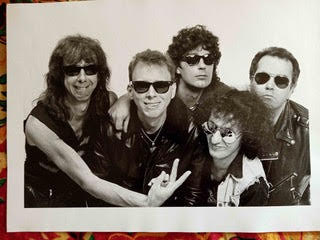
Among other occasional members were another good friend Martin Stone (Savoy Brown, Chilli Willi and the highly underrated psychedelic rockers, Mighty Baby) and the Move’s bassist (and Ball’s frontman), Trevor Burton. In various incarnations and alongside the punkish Warsaw Pakt, the Fairies persisted until 2016 when they reformed, with ex-Deviants George Butler as a second drummist for a slightly, erm, distrait but for me a corking gig at London’s Borderlines Club.
Their 1973 line-up of Russ, Sandy and Larry recorded arguably their finest LP, Kings Of Oblivion, although 1988’s Kill ‘Em And Eat ‘Em (with Andy) runs a close second, both amply demonstrating the heavy metallic nature of their oeuvre which possibly because they didn’t do power ballads or wear spandex, explains why the Fairies never achieved the success of some of their hard-rocking, if less troublesome peers.
Aside from music, Russ lived an unexpected if arguably weird double life as player and later a cricket umpire with an encyclopedic knowledge of the sport, and he was also an avid reader, chess player and master of fiendishly difficult jigsaw puzzles. Particularly during his later life when he suffered from the respiratory illnesses which ultimately killed him – he had been a heroic 30 Marlboro a day man – Russ became a truly supportive friend especially during and following my stay at Her Majesty’s Pleasure and after my wife suddenly left me, and we exchanged lengthy, politically despairing but often darkly hilarious emails right up to a few days before his departure.
Russ is survived by the quietly glamorous and ever supportive Andrea Silver and I must say that my Xmas, which already promises to be a solitary one, will be made even more miserable by his loss. That said, if you can and have friends and family close to hand, do enjoy yours…. Normal service will be resumed in the new year which I hope won’t be as wretched, or bedevilled by further human departures, as this one has been.
IF YOU ENJOYED THIS, OR EVEN IF YOU DIDN’T, WHY NOT SIGN UP TO RECEIVE EMAIL ALERTS TO FUTURE BLOGS USING THE LINK IN THE R.H. COLUMN?
RUNNING OUT OF… TIME, BUT MAYBE NOT December 7, 2023
Posted by markswill in Uncategorized.3 comments
I’ve just be told by an irate reader that the link to my Running Out Of Road site published in my earlier blog doesn’t work and if and until I manage to sort it out, and if you can be arsed, this is what you would’ve found there.
RUNNING OUT OF… TIME
It’s been an age since I last posted here and that’s because I originally intended this as a vehicle (sic) for re-cycling my old Bike and WhichBike? columns which on reflection, are little more than quaint period pieces of no interest to anyone except possibly a few old farts like me who enjoyed motorbiking’s, ahem, glory days in the ‘70s and ’80s.
However – why is there always an ‘however’ you may ask ? – occasionally I still get a bee in my crash helmet which moves me to pound the keyboard, and now is one of those times. Back in the day I made sure that both the aforementioned rags campaigned for our rights and roundly questioned and opposed legislation that came down the pike to curtail them. And even in the early noughties when I wrote for TrailBike & Enduro and MotorCycle Trader magazines, their editors were keen to publish my unusually well-researched rants on such subjects, most notably in the former when an 12+ month long battle to oppose the government’s 2006 Natural Environment and Rural Communities Act. All in vain I’m afraid, so at a stroke we lost our right to ride thousands of miles wonderful off-road trails.
However since then, and even more so since the ‘80s, the rights, the freedoms and even the safe, practical and economic means to keep riding on what used to be called the Queen’s Highways have been emasculated. More complex and onerous licensing requirements, taxation hikes, dangerously unrepaired potholes, metropolitan emission bans and parking costs have all conspired to act against us. Which together with the cost of a half-decent Japanese or Italian bike being on a par with or higher than that of a decent motorcar has steadily reduced the number of m/cycle licence holders to less than + 57% of what they were in the late ‘80s. And majority of those that remain – +63% – are over 55 who, mortgages paid of and kids left home, are the only ones who can still afford to keep riding, albeit mainly on warm, sunny days at speeds way below what their machines are capable of, even if they can find roads without restrictions… and cameras.
With the exception of the British M/cycle Federation’s members–only quarterly and thus rather ineffective magazine, Rider, which, yes, I scribble a column for, none of the mainstream media report on the many threats to our little game – not even the inaptly-named weekly Motor Cycle News, which is now printed on see-through tissue paper redolent of Izal bog-roll… and that includes my own once influential and once-campaigning Bike.
Instead, all of the print and online ‘bike media – like Bike Social and Visordown – are all about promoting sales of the latest, fastest, bestest machinery which only the aforementioned middle-class, middle-aged bikers can afford, and the extraordinarily expensive clothing and gee-gaws that we’re all supposed to lust after. Unsurprisingly then, new ‘bike sales steadily decline year-on-year and more and more dealers go out of business. All of which give me the impression that in ignoring this, the aforementioned specialist media are metaphorical fiddling whilst Rome burns.
What to do if you give a stuff? Well you could email any of the following and berate them for acting the ostrich:
MotorCycle News: mcn.letters@motorcyclenews.com
Visordown: www.visordown.com/contact
Bike Social: enquiries@bikesocial.co.uk.
But failing, or as well as that, you could sign a petition for a battle that is currently exercising me, namely to ‘ London’s Camden Council imposing parking charges for ‘bikes that generally exceed those of cars and in the process are reducing our parking bays. And even if you don’t live there, which a few of my ‘biking pals still do, this could well deter you and I from riding into the metropolis and will also seriously affect the few remaining traders who rely on them. Here’s the link, which I’d urge you to forward to your mates:
savelondonmc.com/camden/petition
Closer to what is now my ‘biking doorstep, a long-ish essay on what the future holds, or probably doesn’t hold for those of us who ride in Wales is worth your concerned consideration: www.britishmotorcyclists.co.uk/wales
IF YOU ENJOYED THIS, OR EVEN IF YOU DIDN’T, WHY NOT SIGN UP TO RECEIVE EMAIL ALERTS TO FUTURE BLOGS USING THE LINK IN THE R.H. COLUMN?


 Mark's Sparks Will Fly Blog